

- Flooring
The Best Flooring for New Construction in Boulder County: A Builder’s Guide
August 31, 2026
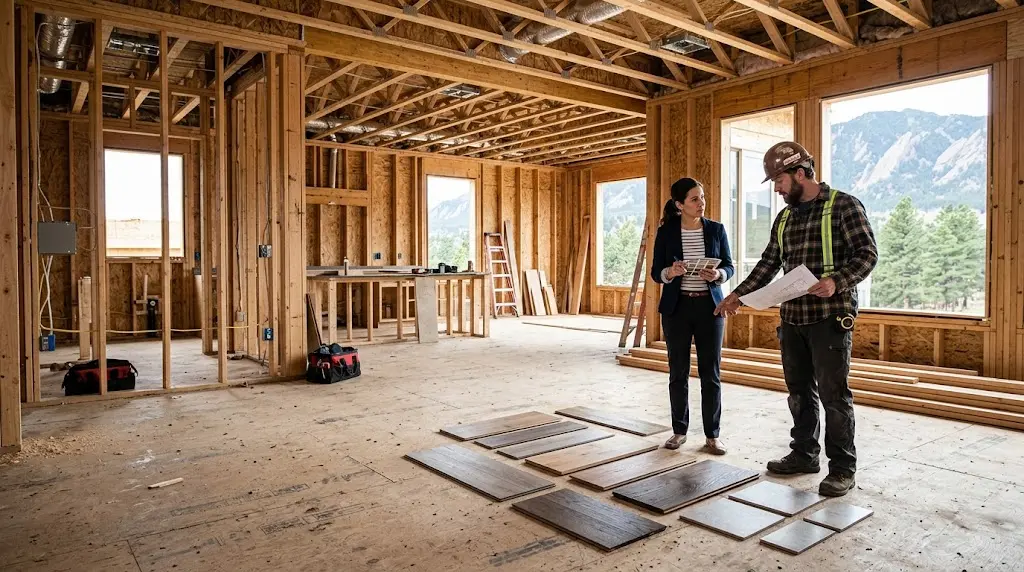
New construction flooring in Boulder County moves on a tight schedule. Builders working in Frederick, Firestone, Mead, Broomfield, and up through the mountains toward Estes Park face consistent pressure: flooring decisions need to be made weeks before the floor goes in, product has to be in stock and on schedule, and the spec has to hold up to buyer expectations without creating callbacks six months after close.
At Star Flooring & Design, we have been the flooring partner for Boulder County builders and contractors since 1963 – serving communities from Estes Park to Broomfield, Mead to Superior. What follows is how we approach new construction flooring room by room: the products that perform in Colorado’s climate, the upgrades worth offering buyers, and the decisions that create problems if they are made wrong.
Why New Construction Flooring Is Different From Remodel Work
In a remodel, the existing floor sets parameters: subfloor condition, height transitions, what adjacent materials are already installed. In new construction, you have a clean slate – and that makes the decisions simultaneously more flexible and more consequential.
The subfloor in most Boulder County new builds is either OSB over wood framing or a concrete slab, depending on whether the space is above or below grade. Getting the flooring spec right means knowing which products perform on which subfloor type, what moisture testing is required before installation, and how the finished floor height interacts with door thresholds, cabinetry, and transitions between rooms.
Colorado’s climate adds its own layer. Boulder County sits between 5,000 and 8,000 feet in most buildable areas, with dry winters that routinely push indoor humidity below 30%. Any wood product installed in a new build needs to be selected with that humidity range in mind – and the home’s HVAC system needs to be operational and running at normal living conditions before wood floors are installed.
Star Flooring Design Team: Builders who work with us know we think about the whole project, not just the floor. We ask about the HVAC timeline, the subfloor type in every zone, and what the buyer profile looks like. A spec that works for a first-time buyer in Frederick is different from what a custom home buyer in Estes Park expects. Getting that right the first time saves everyone a callback six months after close.
Room-by-Room Flooring Specs for Boulder County New Builds
Main Living Areas and Open Floor Plans
Luxury vinyl plank (LVP) has become the dominant choice for main living areas in Boulder County new construction, and for good reason. Rigid-core LVP – SPC (stone-polymer composite) or WPC (wood-polymer composite) – is waterproof, dimensionally stable across Colorado’s humidity swings, and delivers a hardwood aesthetic that satisfies most buyers without the humidity management requirements of real wood. Most residential new construction LVP is installed as a floating click-lock system, which simplifies scheduling and subfloor prep compared to glue-down formats. Glue-down is appropriate for very large open areas or commercial-grade specifications.
For buyers who want genuine hardwood in main living areas, engineered hardwood is almost always the right choice over solid hardwood in Colorado. Brands like Kahrs, Anderson Tuftex, and Eagle Creek Floors offer wide-plank engineered options with the stability needed at Front Range elevation. Solid hardwood can be specified for above-grade installations when the buyer is committed to managing indoor humidity year-round – but that conversation needs to happen before the contract is signed.
Laminate remains a cost-effective option for entry-level builds, but the gap between quality LVP and quality laminate has narrowed enough that LVP is generally the smarter spec – waterproof performance, faster installation, and lower long-term callback risk.
Kitchens
Tile or LVP are the practical choices for kitchen floors in Boulder County new builds. Porcelain tile is the premium option: durable, easy to clean, and compatible with radiant heat systems that are increasingly common in Front Range custom builds. Large-format porcelain – 24×24 or larger – is particularly popular in open-plan kitchens that flow into living areas, creating a seamless visual expansion of the space.
LVP is the practical workhorse for production builds. Waterproof, comfortable underfoot for long cooking sessions, and available in wood-look formats that coordinate easily with cabinetry, LVP installed continuously through kitchen and adjacent living areas simplifies transitions and reduces installation time.
Hardwood in kitchens is an option for custom builds where the buyer wants it and understands the maintenance implications. Engineered hardwood handles kitchen conditions better than solid, but both require more care than tile or LVP in a space that sees water regularly.
Bathrooms
Porcelain tile is the correct call for all bathroom floors in new construction – primary baths, secondary baths, and powder rooms. It is waterproof, mold-resistant, and the only material that handles the full range of moisture conditions a bathroom sees over decades of use.
Tile format and finish are where the design decisions happen. Matte-finish porcelain in large formats reads contemporary and hides water spots better than polished surfaces. Smaller-format tile with tighter grout lines is appropriate for shower floors where slip resistance matters. Boulder County’s design market skews toward natural stone looks and neutral palettes – warm greiges, concrete looks, and soft off-whites perform well.
Handmade and artisan tile is increasingly specified in primary bathrooms of custom builds in Boulder County, particularly in communities around Gunbarrel, Pine Brook Hill, and upper Boulder. Star Flooring carries artisan collections from Bedrosians, Atlas Concorde, and Porcelanosa that no big-box supplier offers.
Bedrooms
Carpet remains the dominant bedroom choice in Boulder County new construction across all price points. It is warm underfoot on cold Colorado mornings, provides acoustic insulation between floors, and satisfies buyers who want a soft-surface option in sleeping areas even when the rest of the home is hard surface.
Shaw Floors, Mohawk, and Dreamweaver offer production-grade carpet collections appropriate for entry-level and mid-range builds. For custom and luxury builds, wool and wool-blend carpet from Godfrey Hirst or Masland is an upgrade worth offering buyers who prioritize natural materials.
Pad specification matters as much as carpet selection in Colorado’s climate. An 8-pound rebond pad is standard for above-grade wood-frame installations. A moisture barrier pad is required for any carpet installed over a concrete slab, whether above or below grade.
Basements and Below-Grade Spaces
LVP is the correct default for below-grade living spaces in Boulder County. Concrete slab moisture is a persistent reality regardless of Colorado’s dry climate – clay-loam soils common to the Front Range retain moisture and the slab sees seasonal variation. Rigid-core SPC LVP handles this well. Solid hardwood should never go below grade. Engineered hardwood can be considered with proper moisture testing and a vapor barrier, but it carries risk that most builders do not want to take on in a production new build.
Tile is appropriate below grade in utility and laundry spaces. For finished basement living areas, LVP is the safest, most installer-friendly option that also delivers the visual quality buyers expect.
“Tracey did a wonderful job assisting with the selection of LVP flooring material. She personally visited the job site and measured the material requirements. Preston did the demolition and the installation flawlessly, demonstrating top notch expertise. The job was accomplished as scheduled and clean up was beyond expectations.”
Steve Y., Boulder – LVP Installation
Three Decisions That Create Callbacks in New Construction Flooring
Skipping Moisture Testing
Concrete slabs need adequate cure time – typically 28 to 90 days depending on conditions – but the controlling factor is moisture content, not time. Moisture readings using ASTM F2170 in-situ RH testing or the calcium chloride test per ASTM F1869 must meet manufacturer tolerances before any flooring installation proceeds. A slab that tests above manufacturer limits needs a moisture mitigation system – not a different product spec. Skipping this step is the single most common source of flooring failures in new Colorado construction.
Installing Wood Before HVAC Is Commissioned
Wood and wood-based products need the home to be at normal living conditions – temperature and humidity stabilized – before and during installation. Installing engineered hardwood in a newly framed, unheated home in January is a path to cupping and gapping complaints from buyers. HVAC must be operational and running for a minimum period specified by the flooring manufacturer before any wood product goes in.
Specifying Transitions After the Fact
Door thresholds, T-moldings, and height transitions between flooring zones need to be part of the original spec, not an afterthought. OSB subfloors in new construction usually require inspection and spot sanding at joist crowns before LVP installation – especially with thin-profile products that show subfloor imperfections more readily than thicker rigid-core options. Flooring height differences that are not addressed at rough-in become expensive corrections after drywall and cabinets are in.
“She was able to help us find flooring that looked great, was within our budget and was in stock. She had the installers in my condo within a day and they finished the work by the end of the week. She is very knowledgeable, personable and flexible.”
Steven K., Boulder – Flooring Installation
Frequently Asked Questions
Do I need to acclimate flooring products before installation in a Boulder County new build?
Yes, for wood-based products. Engineered hardwood and solid hardwood need to acclimate in the conditioned space – with HVAC operating at normal living conditions – for three to seven days before installation, depending on the product and the season. LVP rigid-core products require little to no acclimation, which makes them faster to schedule in a production build. Tile and carpet have no acclimation requirement.
How do I handle flooring across multiple elevation levels in a Boulder County home?
Multi-level homes – common in Boulder County’s hillside communities around Superior, Marshall, and the foothills – benefit from consistent flooring through main living areas and a clear transition plan at level changes. Using the same LVP or hardwood species throughout open-plan living areas unifies the space visually and simplifies installation logistics. Transitions at stair landings and level changes should be specified in the flooring plan, not resolved on-site.
What is the minimum subfloor flatness requirement for LVP installation?
Most rigid-core LVP manufacturers require a subfloor that is flat within 3/16 inch over a 10-foot span. OSB subfloors in new construction usually require inspection and spot sanding at joist crowns before LVP installation, especially with thin-profile products. Concrete slabs often require grinding or leveling compound near plumbing rough-ins where the concrete has been disturbed. Specifying subfloor prep as part of the flooring scope prevents disputes about who is responsible for corrections.
Can Star Flooring work directly with builders and contractors on a project account basis?
Yes. We work regularly with Boulder County builders and contractors across the full project lifecycle – from spec consultation and sample selection through material delivery and installation coordination. Contact us at (303) 444-3411 or stop by our showroom at 5785 Arapahoe Ave, Suite D, Boulder, CO 80303 to discuss your project.
What Boulder County communities do you serve for new construction projects?
We serve the full Boulder County market including Boulder, Longmont, Lafayette, Louisville, Superior, Erie, Broomfield, Frederick, Firestone, Mead, and up through the mountain communities to Estes Park. Our showroom on Arapahoe Ave in Boulder is central to the Front Range communities where most of our builder clients are active.
Partner With Boulder County’s Longest-Running Flooring Showroom
Builders who work with Star Flooring get a flooring partner with 63 years of Colorado new construction experience, a showroom stocked with the products that perform in our climate, and an installation team that shows up on schedule. That matters when your timeline does not have room for surprises.
Bring your plans to 5785 Arapahoe Ave, Suite D, Boulder, CO 80303, or call us at (303) 444-3411 to set up a builder consultation. For a preliminary look at materials and options before your visit, use our virtual estimate tool at modernestimates.com or the Roomvo room visualizer at boulderstarflooring.com/room-visualizer.
You Might Also Like
-
-
-
- Flooring
August 11, 2026
Why Boulder Hardwood Floors Crack and Gap in Winter (And What to Do About It)


