

- Flooring
Why Boulder Hardwood Floors Crack and Gap in Winter (And What to Do About It)
August 11, 2026
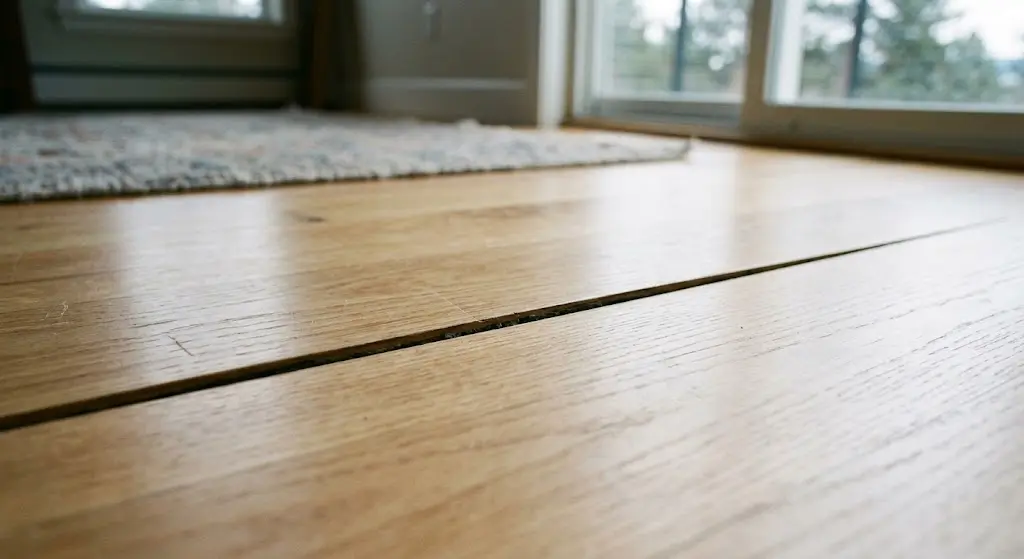
Every winter, our phone rings with the same worried question. A Boulder homeowner walks across their hardwood floor in January, looks down, and sees gaps between the boards that were not there in October. They want to know if their floor is ruined, whether the installer did something wrong, and what it is going to cost to fix. Hardwood floor gaps in Colorado are one of the most common things we see – and one of the most misunderstood. The answer is almost always reassuring, and it starts with understanding what Colorado’s elevation does to wood.
At Star Flooring & Design, we have been helping Boulder homeowners understand their floors since 1963. Seasonal gapping in hardwood is among the most common calls we receive across Boulder County.
Why Colorado’s Elevation Makes This Worse Than Anywhere Else
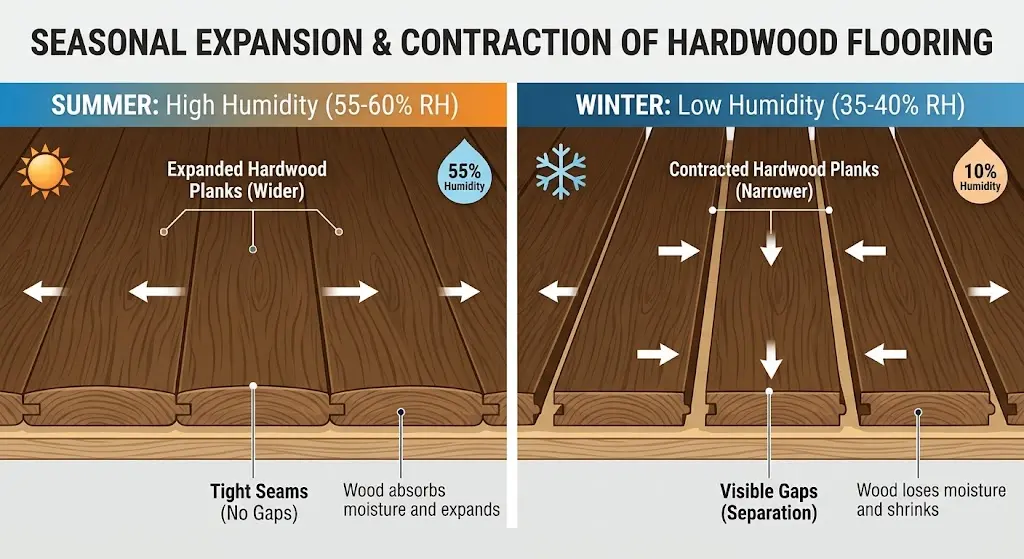
Hardwood floors move. That is not a design flaw. It is the nature of wood, which expands when it absorbs moisture and contracts when it releases it. Every professional hardwood installation accounts for this, which is why installers leave expansion gaps at walls and transitions.
The problem in Colorado is the degree of movement. At 5,430 feet elevation, the air is dry year-round compared to lower elevations. When you add a heating system running through the winter, indoor relative humidity in Boulder homes routinely drops to 20 to 30%. The National Wood Flooring Association (NWFA – nwfa.org) recommends maintaining indoor humidity between 30 and 50% to keep hardwood floors stable. Boulder heating season frequently runs below that floor for months at a time.
The result is predictable: the wood loses moisture, shrinks across its width, and gaps open between planks. Even small gaps across every plank in a 15-foot run create a visibly different floor by February. This same phenomenon explains why seasonal gapping is so common in older homes near Mapleton Hill, Martin Acres, and Table Mesa. Those original oak and fir floors have been expanding and contracting with Boulder’s seasons for decades.
Star Flooring Design Team: The first thing we tell a worried homeowner is to check their humidity. Most of the time, gaps are not a structural problem or an installation failure. They are a sign that the home is running too dry. A quality whole-home humidifier makes a dramatic difference, and we always recommend addressing humidity before anyone starts talking about replacing floors.
Is the Gap a Problem or Just a Season?
Here is how to tell the difference between normal seasonal movement and a genuine issue.
Normal seasonal gapping looks like this: gaps appear gradually from November through February, are roughly uniform across the floor, and close back up or substantially reduce by May when humidity rises again. The boards are flat, the finish is intact, and no edges are lifting.
Investigate further if you see gaps that do not close by summer, boards that are cupped or crowned (edges higher or lower than the center), finish cracking along plank edges, or any board that rocks when stepped on. These symptoms can indicate a moisture problem at the subfloor level, which is a different issue and worth having a flooring professional assess in person.
In Boulder County, subfloor moisture problems are more common in older homes and in newer builds near creek drainages and lower-lying areas of Erie, Louisville, and Superior, where the clay-loam soils common to the Front Range hold groundwater longer after snowmelt.
What You Can Actually Do About It
If your gaps are seasonal, you have three practical paths.
Manage the Humidity
A whole-home humidifier tied to your HVAC system is the most effective solution. For Boulder’s climate, steam humidifiers outperform evaporative models – evaporative units lose efficiency as outdoor humidity drops, which is exactly what happens here in January and February. Steam humidifiers maintain consistent output regardless of outdoor conditions. Portable room humidifiers help in targeted areas but rarely sustain the 30 to 50% RH that hardwood needs across an entire floor.
One maintenance note: avoid steam mops and wet mopping near open gaps. Use a soft-bristle vacuum attachment and a barely damp microfiber cloth. Water forced into seasonal gaps accelerates the very damage you are trying to prevent.
Live With It
Many Boulder homeowners with older solid hardwood floors simply accept seasonal gapping as part of owning a wood floor in a dry climate. The gaps close each spring. If your floor is otherwise performing well – flat, stable, no cupping – this is a completely reasonable position. The main tasks are keeping gaps clean and watching for the warning signs listed above.
If you want to address the appearance of gaps without a full replacement, flexible latex or polymer gap fillers (matched carefully to your floor’s finish color) can reduce the visual impact of moderate gaps. Avoid rigid wood fillers for floors that continue to move seasonally – they will push out as the boards expand and leave a worse result than the original gap.
Consider an Upgrade When the Floor Reaches the End of Its Refinishing Life
Solid hardwood can be sanded and refinished multiple times, but each sanding removes material. When the floor has been refinished to the point where no more sanding is possible, replacement is the natural next step. At that point, the seasonal gapping conversation becomes a strong argument for choosing differently.
“Mick at Star Flooring was incredibly helpful because he cared more about doing what’s right than the sale itself. He shared helpful opinions and advice when I was confused or didn’t know what to do. He was honest about what would work well and what wouldn’t.”
Boulder Homeowner – Flooring Consultation
When It Makes Sense to Replace
Not every hardwood floor with seasonal gapping needs to be replaced. But some situations tip the calculation toward a smarter upgrade.
Engineered hardwood is the most natural replacement for solid hardwood floors in Boulder. It carries a real wood surface – the look, the warmth, the refinishability – with a cross-ply core that resists the dimensional movement solid wood cannot. Brands like Kahrs, Eagle Creek Floors, and Provenza are built for dimensional stability, which is what matters at Front Range elevation. You get the real wood floor you want without the annual gap conversation.
Luxury vinyl plank (LVP) is the right call for homeowners who want to eliminate the humidity management requirement entirely. Modern rigid-core LVP from brands like TRUCOR and Karndean is waterproof, dimensionally stable across Boulder’s full seasonal humidity range, and installs over existing subfloors without the acclimation requirements of wood.
“Excellent service on installation. The team was courteous, efficient and worked hard to get the job done quickly and perfectly.”
Kathleen M., Boulder – Flooring Installation
Frequently Asked Questions
Are the gaps in my hardwood floor permanent?
Most seasonal hardwood floor gaps in Colorado are not permanent. They open as indoor humidity drops during heating season and typically close or substantially reduce when humidity rises again in spring and summer. If your gaps have not closed by June, or if you see cupping or edge lifting alongside the gaps, that warrants a professional look – it may indicate a subfloor moisture issue rather than simple seasonal movement.
How much humidity do I need to keep my hardwood floors from gapping?
The NWFA (nwfa.org) recommends maintaining indoor relative humidity between 30 and 50% for most hardwood species. Boulder homes in winter without active humidification often run well below 30%. A whole-home humidifier – preferably steam-type for Colorado’s dry winters – set to 35 to 40% RH through the heating season keeps most solid hardwood floors significantly more stable. A standalone hygrometer lets you monitor your home’s actual RH and know when to adjust.
Can the gaps be filled?
It depends on the filler. Rigid wood fillers are not recommended for floors that move seasonally – they will be pushed out when the boards expand in spring. Flexible latex or polymer fillers designed for floating floors can work acceptably for moderate gaps if matched carefully to your floor’s finish color. For severe gapping or floors near the end of their refinishing life, replacement with engineered hardwood or LVP is a better long-term solution.
My gaps appeared after a renovation. Was something installed wrong?
Not necessarily. New HVAC systems, insulation improvements, or window replacements can change how a home manages humidity – often making it drier, which accelerates gapping in existing hardwood. If the gaps appeared specifically after a renovation and the floor was stable before, check whether anything changed about your home’s humidity levels before assuming an installation problem.
Should I worry about gaps letting in drafts or bugs?
Normal seasonal gaps in hardwood floors – typically 1/32 to 1/16 of an inch – are not a significant draft or pest entry point. They are surface-level movement in the wood itself, not openings in the subfloor structure below. If you can feel air movement through the floor or see light from below, that is a subfloor or substructure issue separate from the hardwood and worth investigating independently.
Talk to Someone Who Knows Boulder Floors
If you are seeing seasonal gaps and not sure whether to manage them, refinish, or replace, the most useful next step is a conversation with someone who has seen thousands of Boulder County floors. We serve homeowners and builders from Estes Park down through Boulder, Louisville, Superior, and Broomfield – and we have been doing it since 1963. There is very little we have not seen at elevation.
Stop by our showroom at 5785 Arapahoe Ave, Suite D, Boulder, CO 80303. No appointment needed. You can also reach us at (303) 444-3411. If you are already thinking about replacement options, try our Roomvo room visualizer at boulderstarflooring.com/room-visualizer to see how engineered hardwood or LVP would look in your actual space before you come in.
You Might Also Like
-
- Flooring
August 31, 2026
The Best Flooring for New Construction in Boulder County: A Builder’s Guide
-
-